




Return to the Republic of Calvard in Trails through Daybreak II.
August 17, 2026
Discover and relax in Yoshi and the Mysterious Book.
September 8, 2026
In Greek mythology, the titan Epimetheus is the lesser-known brother of Prometheus. Epimetheus is sometimes said to be the titan that gifted traits and abilities to all non-human creatures. Other stories depict him as a bumbling oaf that opened Pandora’s Box. In Astalon: Tears of the Earth, Epimetheus is the Titan of Death. He’s depicted with a skeletal ram head, massive claws, and seemingly unlimited power. One of the three main characters in Astalon has a pact with Epimetheus. Sadly, said pact is the only way said character and his two traveling companions will be able to survive their journey through the Tower of Serpents. But, I’ll get more into that later. Astalon is a 2D throwback that rewards quick reflexes and perseverance similar to the classic Nintendo games its sprites are modeled after. After digging deeper and getting killed a few times, it’s clear that there’s a lot to it. Astalon has the best parts of a Metroidvania, an RPG, and a platformer. It also has the worst parts of rogue-like and a Souls-like. All of this comes together in a highly addictive and satisfying game. It’s challenging, but I recommend it to everyone.
In a post-apocalyptic desert, three friends traverse the scorching sands to reach the Tower of Serpents. This tower is said to be the source of poison that’s infecting the water source of their village. The three heroes are Arias, Kyuli, and Algus. Arias is a swordsman whose dad is known as the legendary Crystal Swordsman. Kyuli is a rogue armed with a sunny disposition and a bow and arrow. Algus is a wizard that formed the above-mentioned pact with Epimetheus. The pact allows Algus and his friends to come back to life no matter how many times they get killed in the tower. Along the way, the three will encounter a powerful knight clad in black armor, monstrous gorgons, and maybe a few allies willing to assist in their cause. The premise is simple, but there’s a surprising amount of development and dialogue in Astalon. I found myself cheering on the three heroes and enjoyed getting to know them. The Titan of Death has his own bits of dialogue that shed more light on the origins of the tower, his pact with Algus, and other interesting facets. Sure, the gameplay is where Astalon is at its best but pay attention to the story.
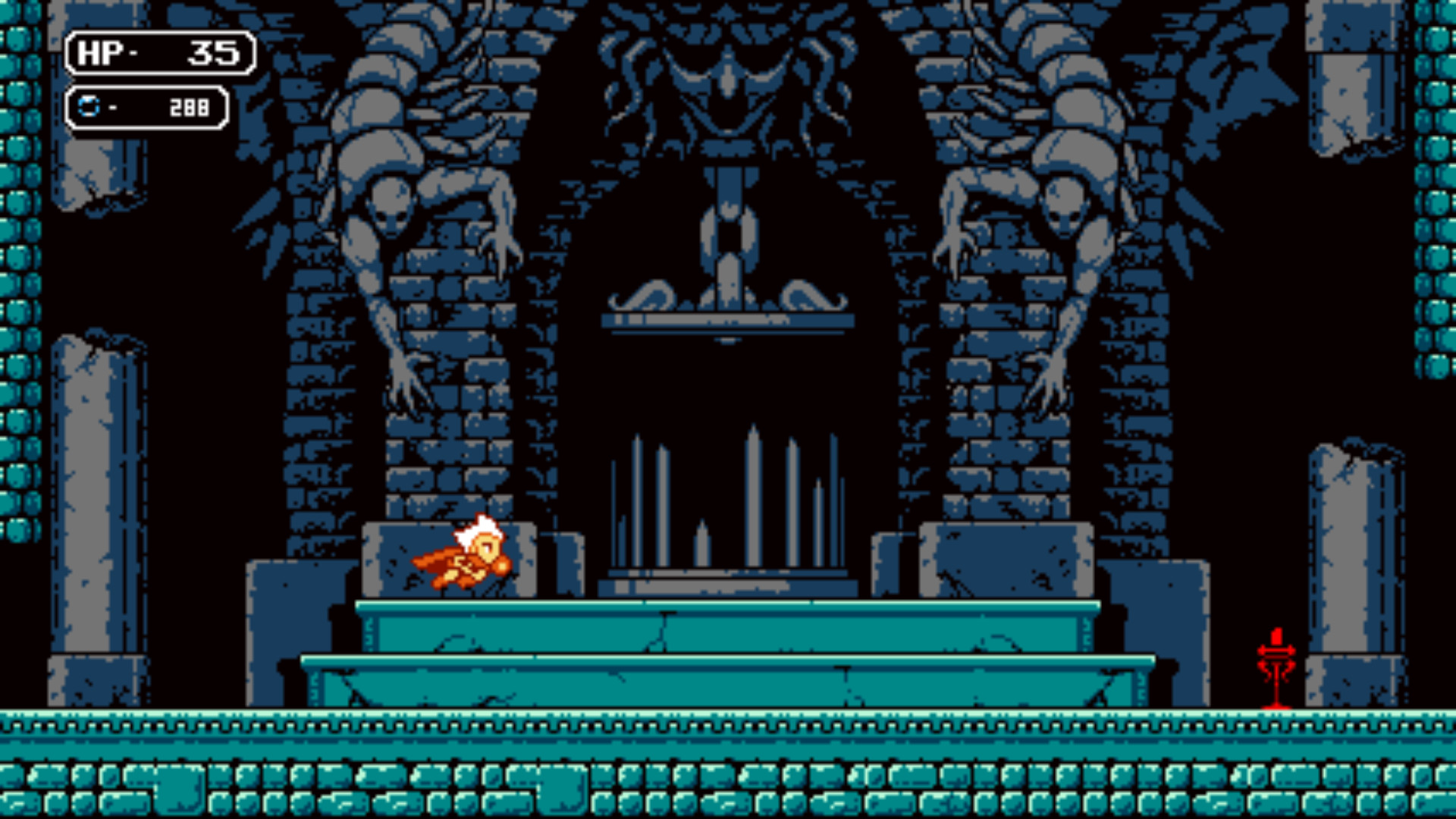
I’ll talk about the gameplay in a second. First, I want to shine the spotlight on the presentation. Obviously, the game market is saturated with 2D pixelated games that pay homage to earlier eras. Does anything about Astalon’s look set it apart from its peers? At first glance, no. There are some nice “cut scenes” and the characters move well, but it’s nothing we haven’t seen before. The music is catchy but it’s nothing that will have you cranking up the volume. However, players that take a closer look to admire the tower itself will see impressive, creepy, and unsettling details. Sure, the massive tower is filled with enemies, but the backgrounds and atmosphere make it more of a living monstrosity than a tower. Then, there are the bosses: highly detailed, fluidly animated, bizarrely designed, and oh-so-satisfying to topple after landing a final blow. Just like the story, Astalon’s presentation is worth paying attention to because the tower has a lot of hidden detail.
I’ll admit that I almost dropped Astalon within the first hour or so. That’s because I found the gameplay to be both uninspired and frustrating. The game doesn’t give a good first impression. Arias has short range but attacks rapidly. Kyuli can attack from a distance and do a small double-jump off walls. Algus can shoot fireballs that can activate certain switches. Once the game begins proper and it’s time to navigate your way to the top of the tower, it’s clear that the developers wanted you to constantly die. Arias, Kyuli and Algus share a health bar. If one hero dies, then they all die. Gamers of a certain age and with niche taste might remember From Software’s Forever Kingdom on the PlayStation 2 in which the three heroes were cursed with shared health.
The premise is similar in Astalon. Unlike Forever Kingdom, you can’t swap characters. At least not initially. There’s a special item you need to find that lets you do that. So, if there’s an obstacle that can only be overcome by a specific character, then you’re forced to head back to the nearest save point to swap. Enemies respawn when you return to a room. Most of the rooms contain traps and hazards. The only way to recover health is to break candles illuminated with green fire. You must spend soul orbs to restore them.
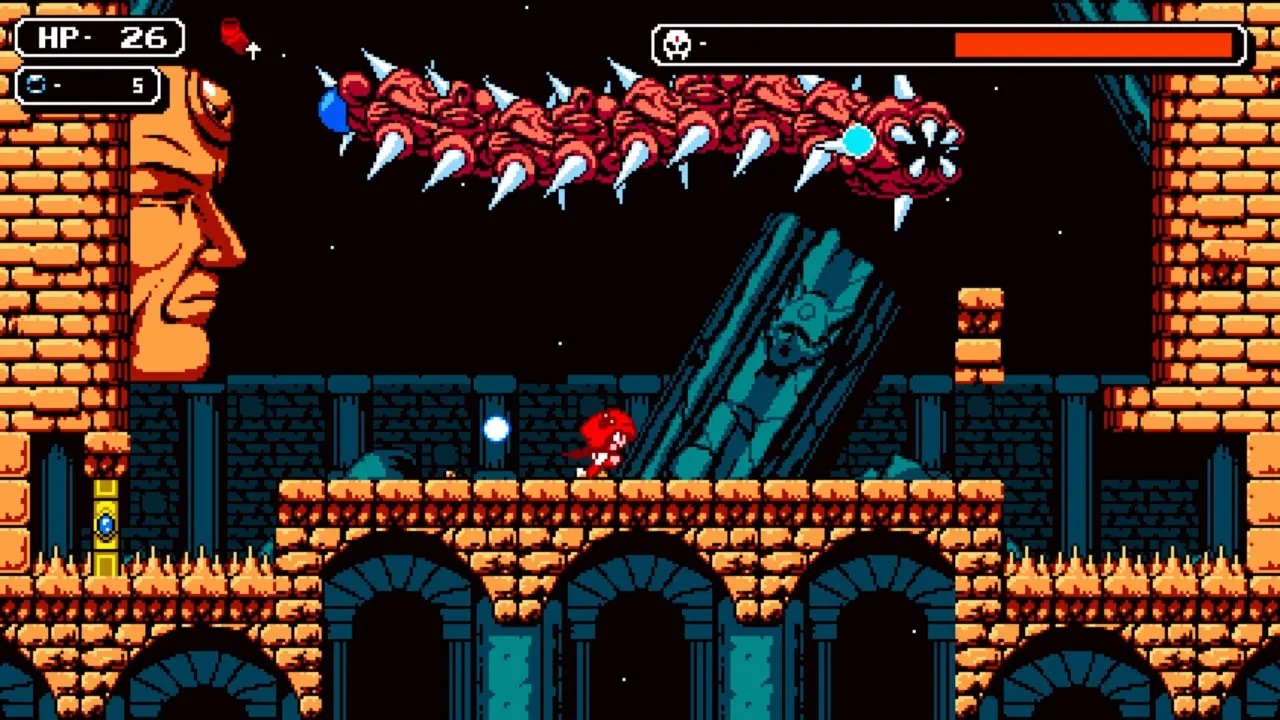
Death in Astalon means starting at the tower’s entrance, but it also means meeting with Epimetheus to exchange soul orbs from enemies and treasures for upgrades. Orbs are used to improve base stats like defense and attack speed, but also can be used to purchase character specific specialties and boons for the map. Since enemies respawn each time you enter and exit a room, you could technically spend time farming orbs to get what you need. However, even with new upgrades and improved stats, Astalon is still a challenge. The map was huge. Shortcuts weren’t as a prevalent as I would have liked. A lot of the rooms are locked by colored keys. They’re easy to find, but it can feel demoralizing when you reach a new part of the map only to see that you’re missing a key. I think it took me a couple of hours to finally “get it” in terms of how to go about things. After things clicked it was hard to put the game down. The addictive gameplay loop and the promise of discovery thanks to the tower’s Metroidvania structure meant coming back for more no matter how many times my party met a bitter end.
I earned 100% completion in the main campaign after about 20 or so hours. Finishing the game unlocks new modes. Personally, the main campaign was enough. I was pleased to see the game end when it did. I know that there are options on top of options for games designed like Astalon, but there is something special here. No single aspect of it is exceptional. But, all aspects come together in an exceptional way to make the game fun. It takes some time for the loop to get going. Once it does, Astalon: Tears of the Earth turns into a highly enjoyable adventure that will hopefully continue to get recognized as more throwback titles get churned out.
Overall, 8/10: Algus, Kyuli and Arias have an uphill battle ahead of them in a challenging yet satisfying journey. Astalon: Tears of the Earth takes a while to adapt to but it’s worth doing so.
